
John Snow and the Invisible Killer: How One Doctor Traced a Disease No One Could See
Long before anyone had seen a bacterium under a microscope, one quiet doctor proved that an invisible killer was hiding in plain sight.
Short on time? We’ve got you covered — click here to get a crisp & short summary on the story of John Snow.
SummaryA Story Almost Everyone Gets Wrong
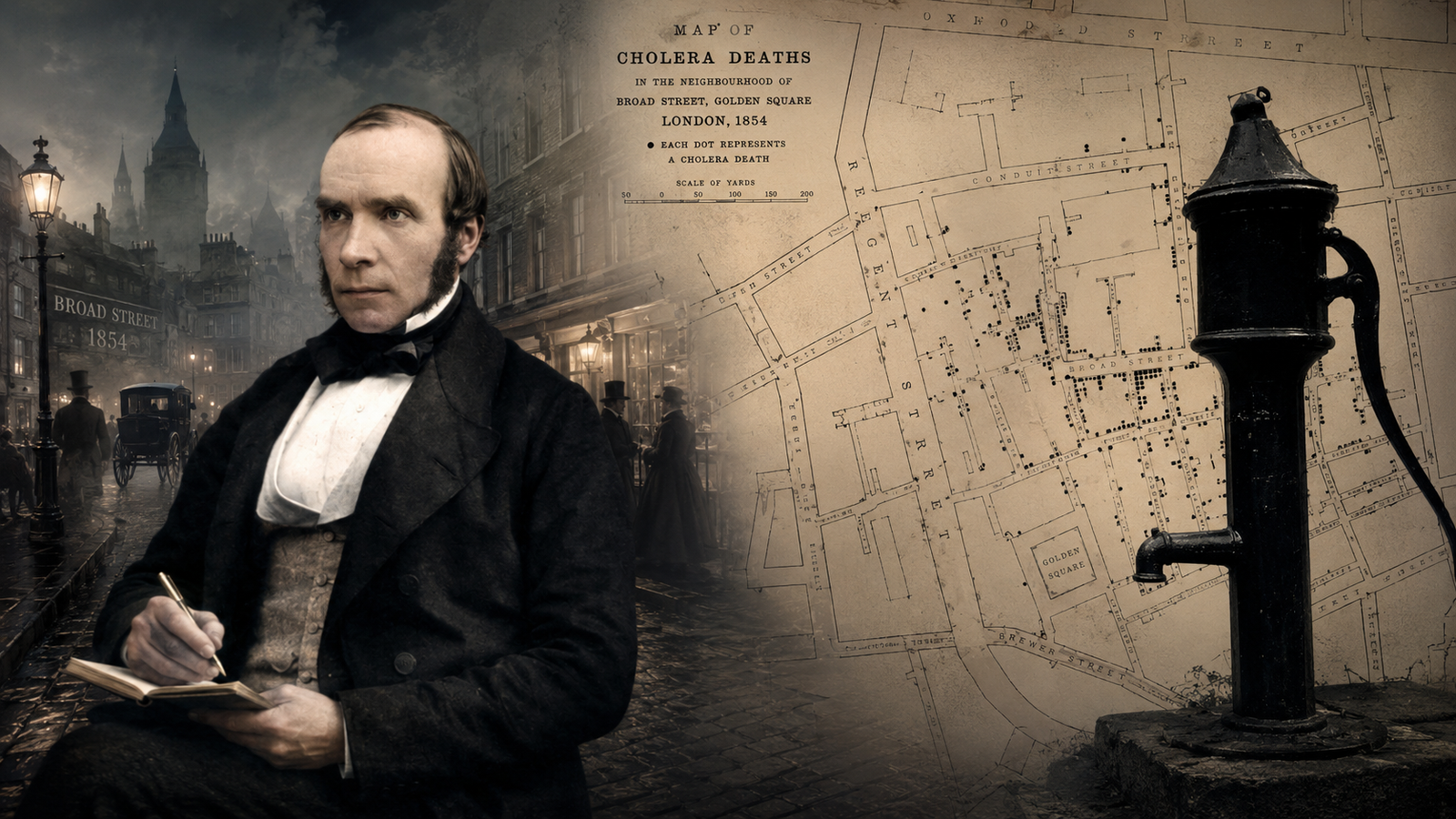
If you’ve ever studied public health, you’ve probably heard the story of John Snow. It usually goes like this: cholera struck London in 1854, Snow mapped the deaths, found them clustered around the Broad Street water pump, had the pump handle removed, and the outbreak ended — earning him the title Father of Modern Epidemiology. It’s a wonderful story: simple, inspiring, and easy to remember. The only problem is that it isn’t really what happened.
Yes, Snow created one of history’s most famous disease maps. Yes, the pump handle was removed. And yes, his work founded modern epidemiology. But those events are only a small part of a much larger story — one about a city unknowingly poisoning itself, a doctor who challenged the most respected scientific theory of his time, and years of patient investigation that changed how we understand disease. To appreciate it, we first need to travel back to Victorian London: a city that looked magnificent from a distance but hid a deadly secret beneath its streets.
 Add image URL
The Greatest City in the World — and One of the Dirtiest
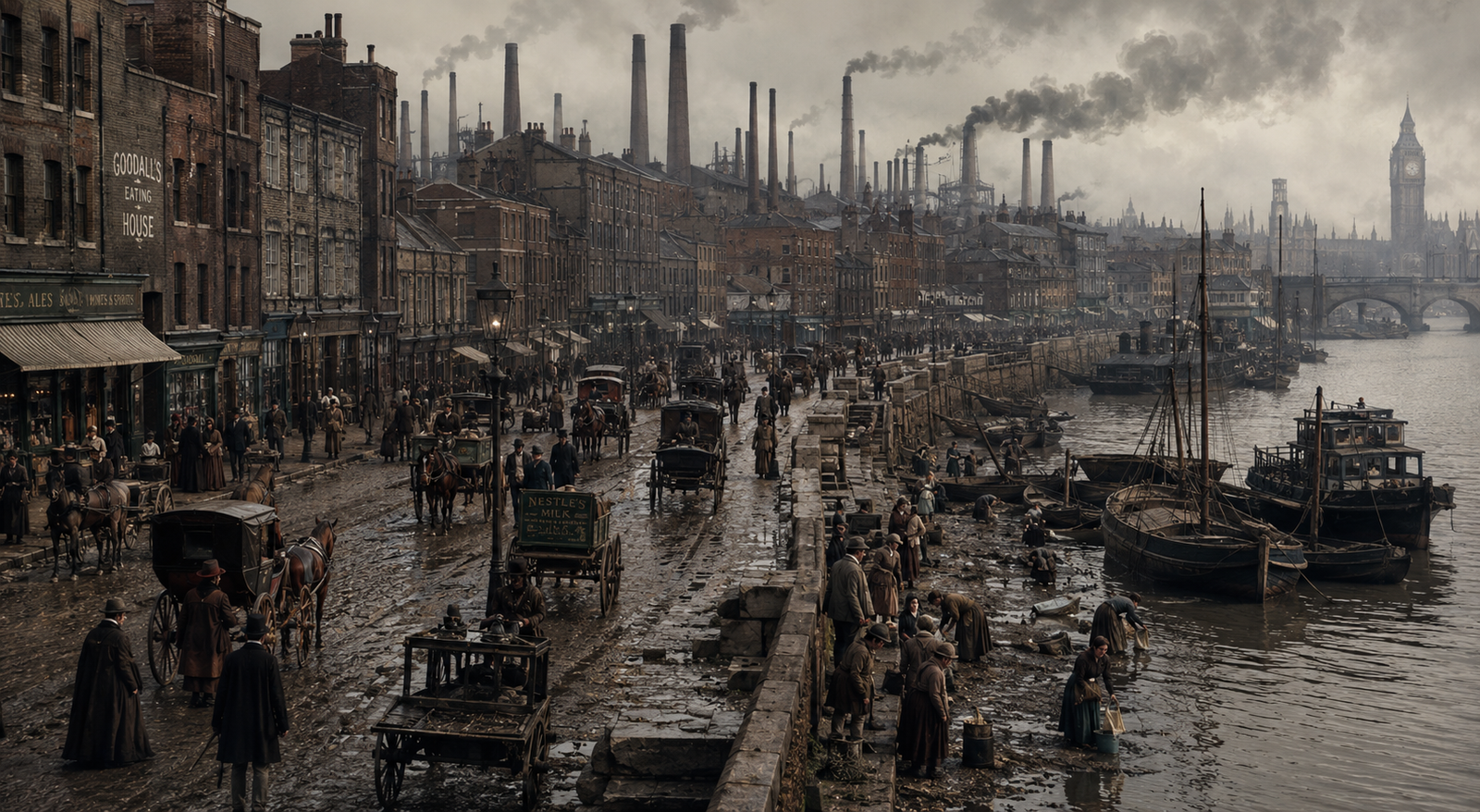
Imagine arriving in London in the summer of 1854. At first glance it is breathtaking: horse-drawn carriages on cobbled streets, factory chimneys rising into the skyline, markets overflowing with merchants. London is the heart of the British Empire — the wealthiest, most powerful city on Earth.
But within minutes, something else demands your attention: the smell. Open drains run beside homes, horse manure carpets the streets, overflowing cesspits leak into the soil, and slaughterhouses and factories dump their waste wherever they can. Every day, thousands of gallons of human sewage flow into one place: the River Thames.
Ironically, the same river that carries away the city’s waste also supplies drinking water to hundreds of thousands of Londoners. Families draw water from it, children drink it, restaurants cook with it. Nobody boils it. Nobody filters it. Nobody suspects it. To us this sounds unimaginable — but to Victorian Londoners, it was simply normal life.
 Add image URL
Sudden Death, and a Theory That Made Perfect Sense
Cholera was one of the most terrifying diseases of the nineteenth century because it arrived so suddenly. A person could wake up perfectly healthy, be vomiting and suffering severe diarrhea by midday, and be dead before the next sunrise. Entire families disappeared within days. Doctors were helpless — there were no antibiotics, no intravenous fluids, and no one even knew what caused it. Some blamed foreigners, others poverty; many believed it was God’s punishment. Everyone had an opinion. Very few had evidence.
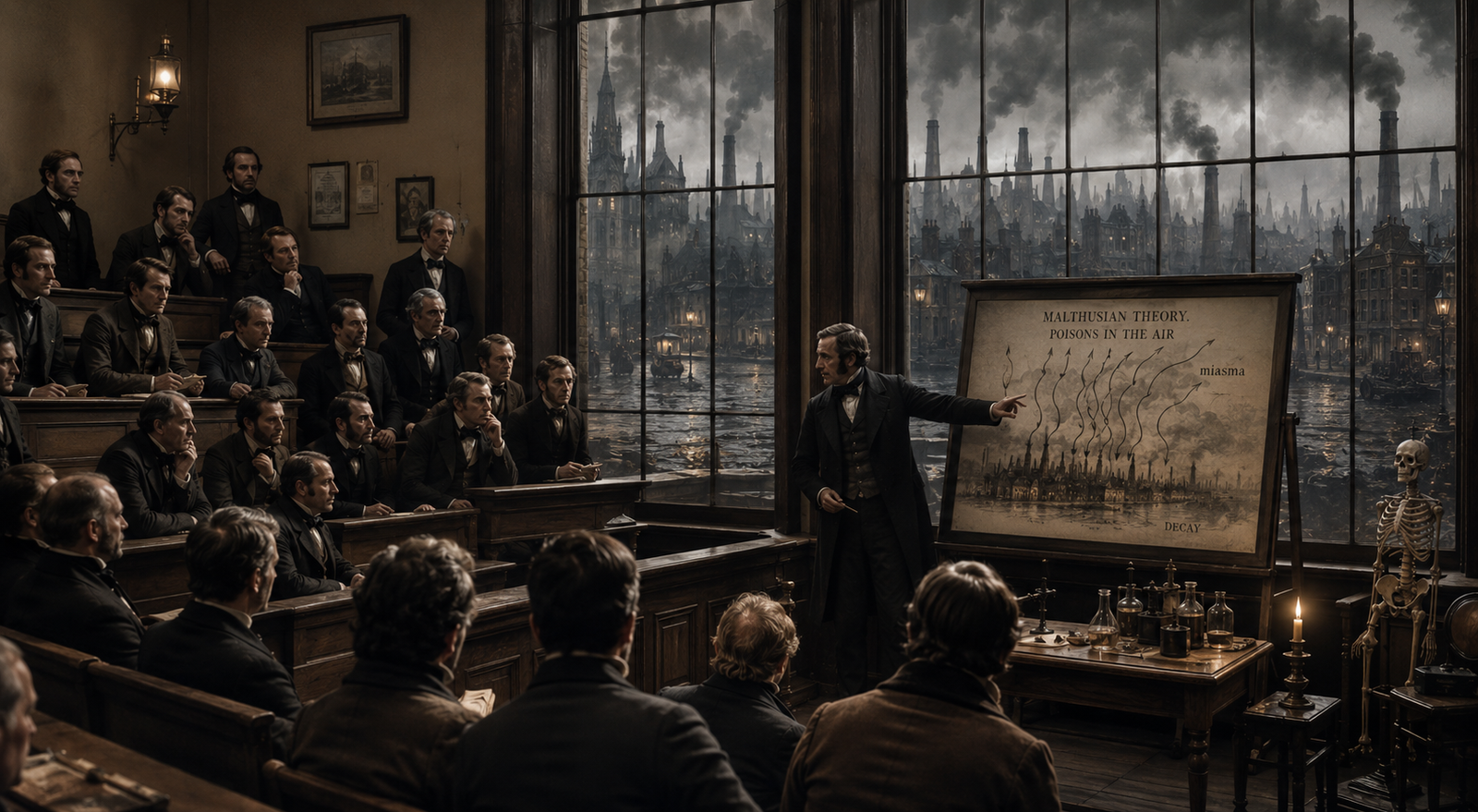
Doctors weren’t ignoring cholera, though — they believed they already understood it. One explanation dominated: the Miasma Theory, which held that disease came from breathing foul-smelling air rising from decaying matter. The worse something smelled, the more dangerous it was thought to be. In Victorian London this seemed reasonable: the filthiest neighbourhoods were the poorest, smelled terrible, and suffered the worst outbreaks, so people assumed the smell itself was making them sick. No one knew about bacteria; the word “germ” had not yet entered everyday medical language. The Miasma Theory wasn’t ignorance — it was the best explanation available, and almost every physician accepted it without question. Almost everyone.
 Add image URL
A Doctor Who Couldn’t Stop Asking Questions
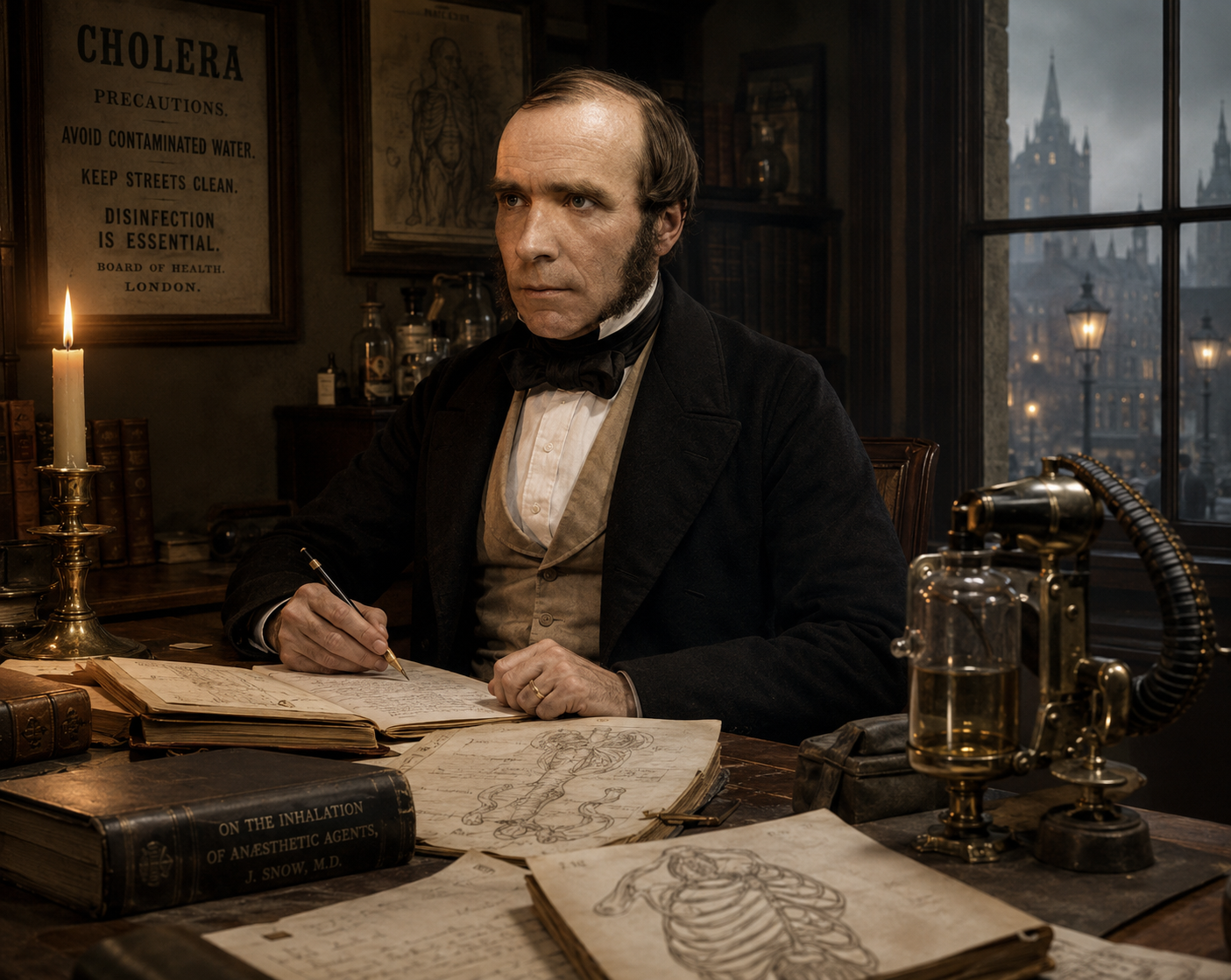
Among London’s thousands of doctors was a man who saw things differently: John Snow. He wasn’t wealthy or politically influential, and most people knew him not as a public health expert but as one of Britain’s leading anesthetists. At a time when anesthesia was still new and controversial, he had earned a reputation for precision, designing specialized inhalers that let him carefully control each patient’s dose. His reputation grew so great that Queen Victoria herself requested his services during the births of Prince Leopold in 1853 and Princess Beatrice in 1857 — a royal endorsement that made anesthesia socially acceptable across Britain almost overnight.
Snow could have spent his career on anesthesia and lived comfortably. But one question nagged at him. Every time cholera swept through London, he noticed something that didn’t fit the accepted explanation: if bad air caused cholera, why did the disease attack the stomach instead of the lungs? It was a simple question, yet almost no one was asking it — and it would lead him to challenge an entire medical establishment.
“Every great scientific discovery begins with someone asking a question everyone else has stopped asking.”
 Add image URL
“Sometimes the biggest discoveries don’t begin in a laboratory. They begin with a simple question, a notebook, and the courage to walk where everyone else is running away.”
The Soho Outbreak
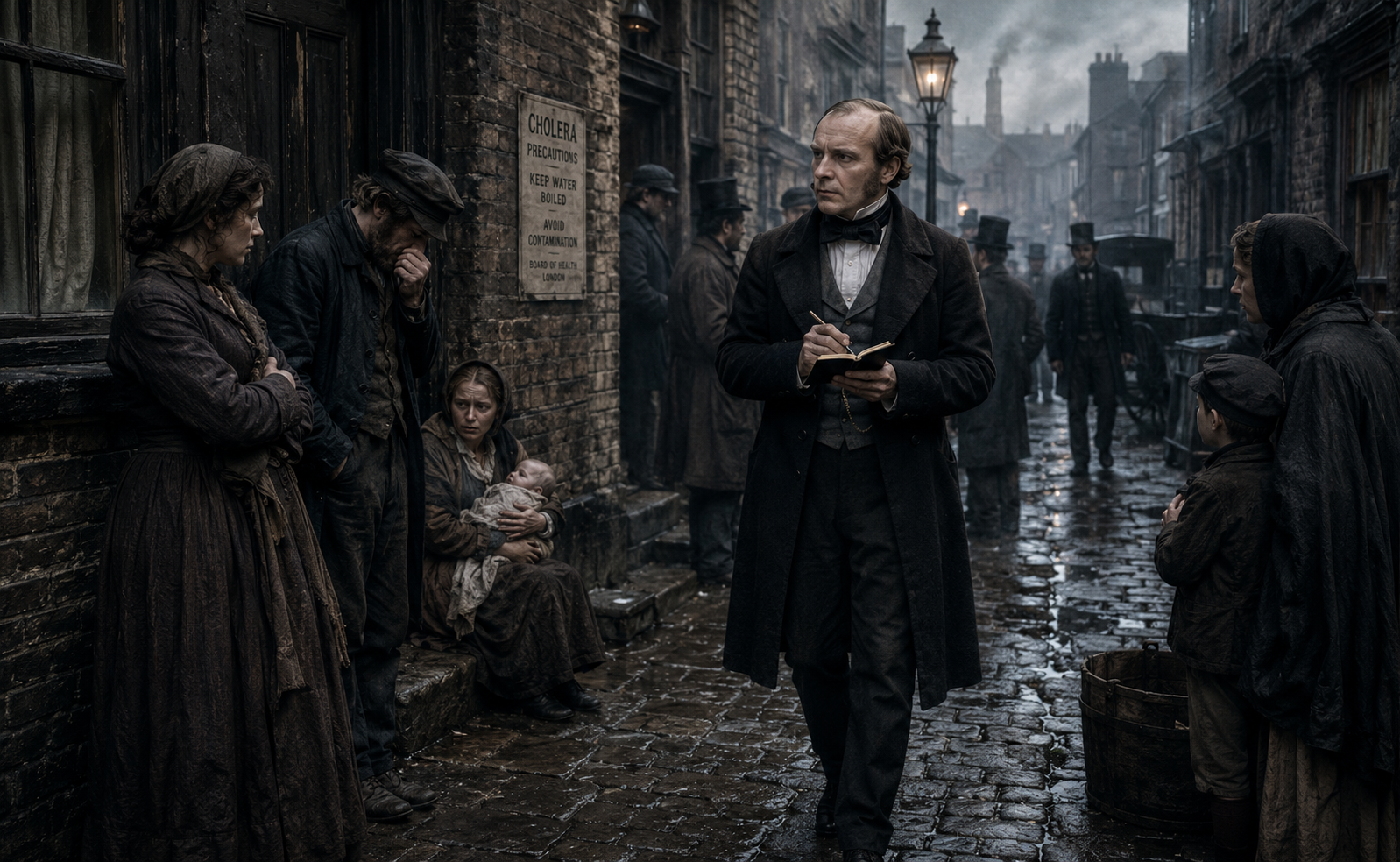
By the end of August 1854, Snow’s theory had never been tested on a large scale. He believed cholera spread through contaminated water, but belief alone wasn’t enough. Then, as if history had decided to put his theory on trial, cholera returned — striking the bustling neighbourhood of Soho, in the heart of London. What began as a few isolated illnesses became a nightmare: healthy people collapsed in their homes, on the streets, at work, and in just ten days more than 500 people died within a small area around Broad Street. Panic swept through Soho and thousands fled. But while most people ran from the outbreak, one man walked quietly toward it.
Snow wasn’t carrying medicine. He was looking for answers. Day after day he visited the homes of the dead, spoke with grieving relatives, searched official death records, and recorded every address with precision. He wasn’t relying on rumour — he wanted facts. Slowly a picture emerged: if cholera really spread through contaminated water, the victims shouldn’t be randomly scattered. They should form a pattern.
 Add image URL
The Map That Revealed the Invisible
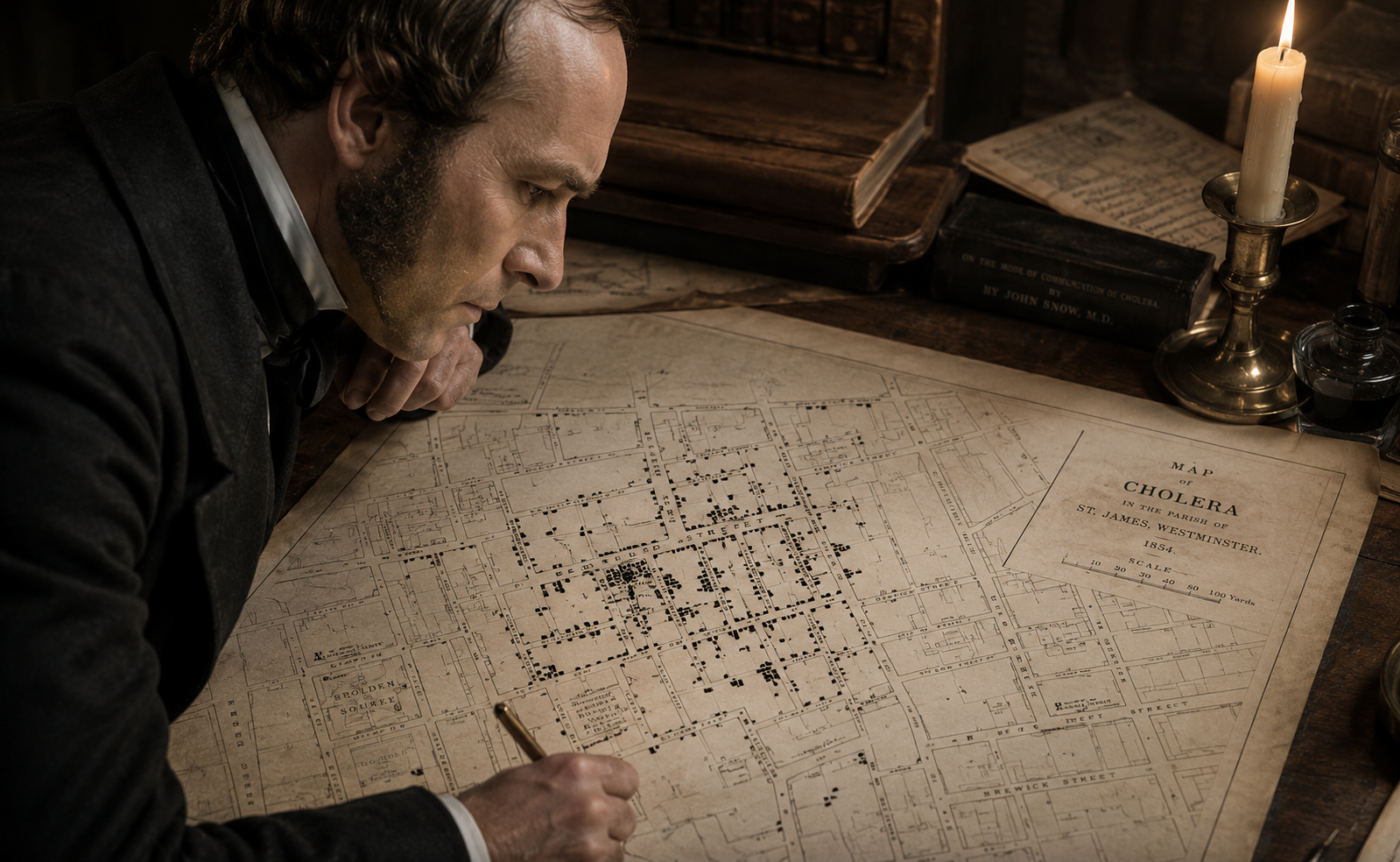
Back in his study, Snow transferred every recorded death onto a street map, marking each victim with a small black bar. At first the marks seemed random. But as the map filled, something extraordinary happened: the scattered marks formed a clear pattern. Almost every death clustered around a single location — the public water pump on Broad Street.
Snow stared at the map. If his theory was correct, this wasn’t coincidence. The pump wasn’t simply in the middle of the outbreak — it might be causing it. Today this map is considered one of the greatest achievements in the history of epidemiology. It showed that maps could reveal relationships almost impossible to see by looking at individual cases. For the first time, geography had become a powerful medical tool.
 Add image URL
A Scientist Tries to Prove Himself Wrong
Many people think Snow solved the mystery the moment he saw the cluster. But finding a pattern is only the beginning of science, because coincidence can create patterns too. To convince others, Snow had to challenge his own theory. So instead of asking “Who became sick?” he asked a more important question: “Who didn’t?”
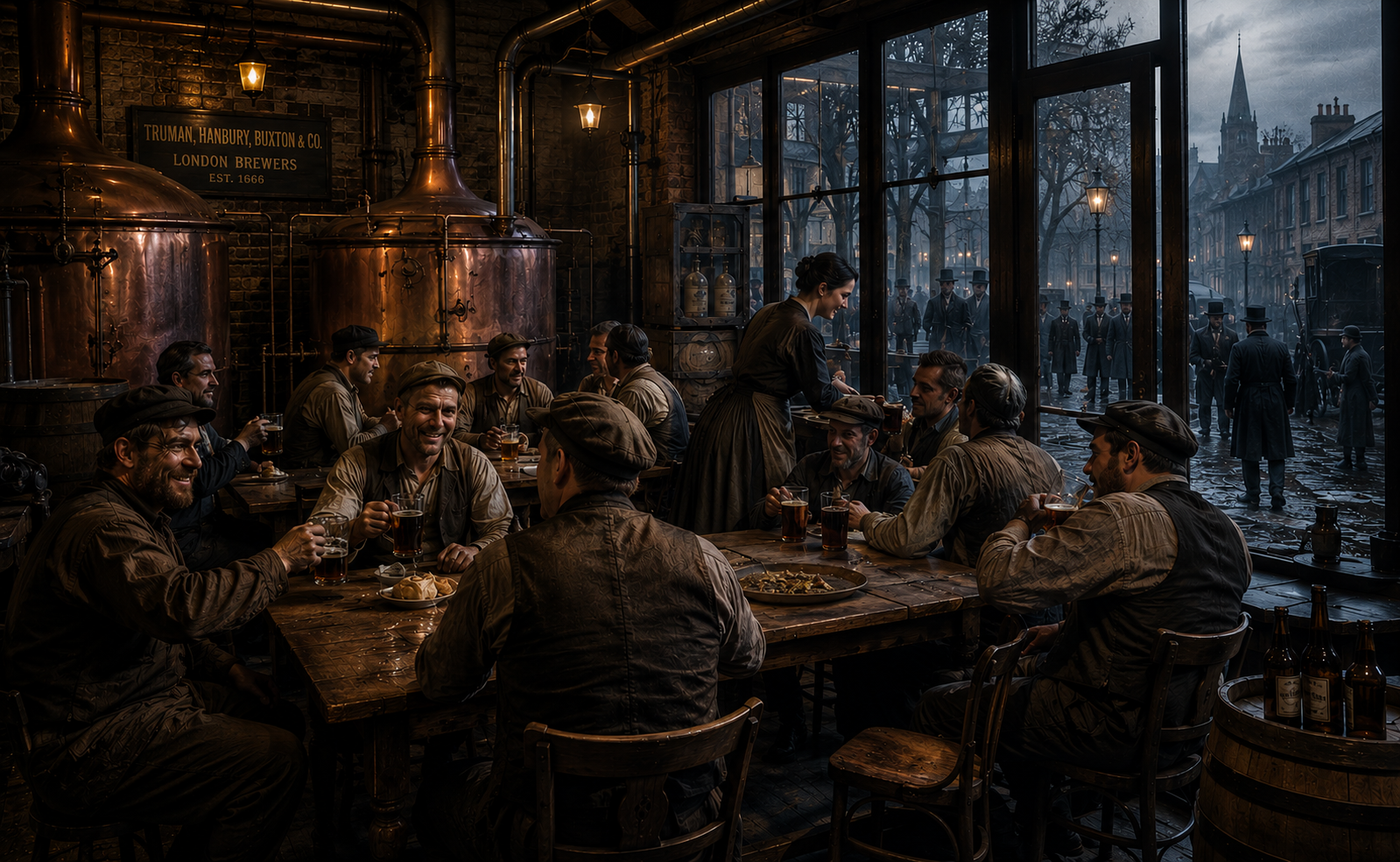
Just a short distance from the pump stood a busy brewery where hundreds of workers spent their days. If the pump was contaminated, the brewery should have been devastated — but very few workers fell ill. Snow discovered why: the workers rarely drank pump water. They drank beer brewed on site, and so were unknowingly protected. The brewery hadn’t disproved his theory; it had strengthened it.
A nearby workhouse told the same story. Housing hundreds of residents just metres from the pump, it should have been hit hard — yet few died. The reason: it had its own private well. Every place that avoided the pump avoided cholera; every place that relied on it suffered. Snow’s theory was becoming harder and harder to dismiss.
 Add image URL
Removing the Pump Handle
Armed with his map and observations, Snow appeared before the local Board of Guardians, the officials responsible for public health in the parish. The deaths weren’t random, he argued — they were concentrated around a single water source, and the pump should be closed at once. The officials listened politely but remained skeptical; the Miasma Theory had dominated medicine for decades. Still, faced with a mounting death toll and little to lose, they agreed to an experiment and ordered the handle of the Broad Street pump removed. It was a simple act — one iron handle unscrewed from one pump — yet it would become one of the most famous symbols in the history of medicine.
This is usually where the story ends: the handle comes off, the epidemic stops, Snow becomes a hero. But history is rarely that neat. The outbreak had already begun to slow, because fear had driven many residents to leave Soho. So did removing the handle instantly end the epidemic? No. But it almost certainly prevented further infections among those who remained, and it focused attention on the pump — pushing investigators to search for the true source of contamination. The most important discovery was still waiting to be made.
“The pump handle became famous not because it magically stopped cholera, but because it symbolized something more powerful — acting on evidence before everyone else believed it.”
 Add image URL
“The greatest discoveries are rarely made alone. Sometimes they happen when two people who disagree decide to search for the truth together.”
An Unexpected Ally
When the handle came off, most people believed the crisis was over. Cases fell, shops reopened, and Soho tried to recover. But Snow still couldn’t answer the most important question: how had the water become contaminated in the first place? Without that answer, critics could still argue the pump was merely near the outbreak, not the cause of it. Snow needed a source, not just a pattern.
One of the people who doubted him was Reverend Henry Whitehead, the local parish priest, who knew almost every family in Soho personally. Whitehead believed the pump had an excellent reputation and set out to prove Snow wrong. Ironically, that decision would lead him to prove Snow right. Relying on human stories rather than maps, he went house to house asking survivors where they drew their water and when their loved ones first fell ill. One case caught his attention: a woman who lived miles from Soho had died of cholera. Her death made no sense — until Whitehead learned she had once lived in Soho and loved the taste of the Broad Street water so much that she had bottles of it delivered to her new home. Even after moving away, she kept drinking from the very pump at the centre of the outbreak. To Snow, this was powerful evidence: distance didn’t matter. The water did.
 Add image URL
The Hidden Leak
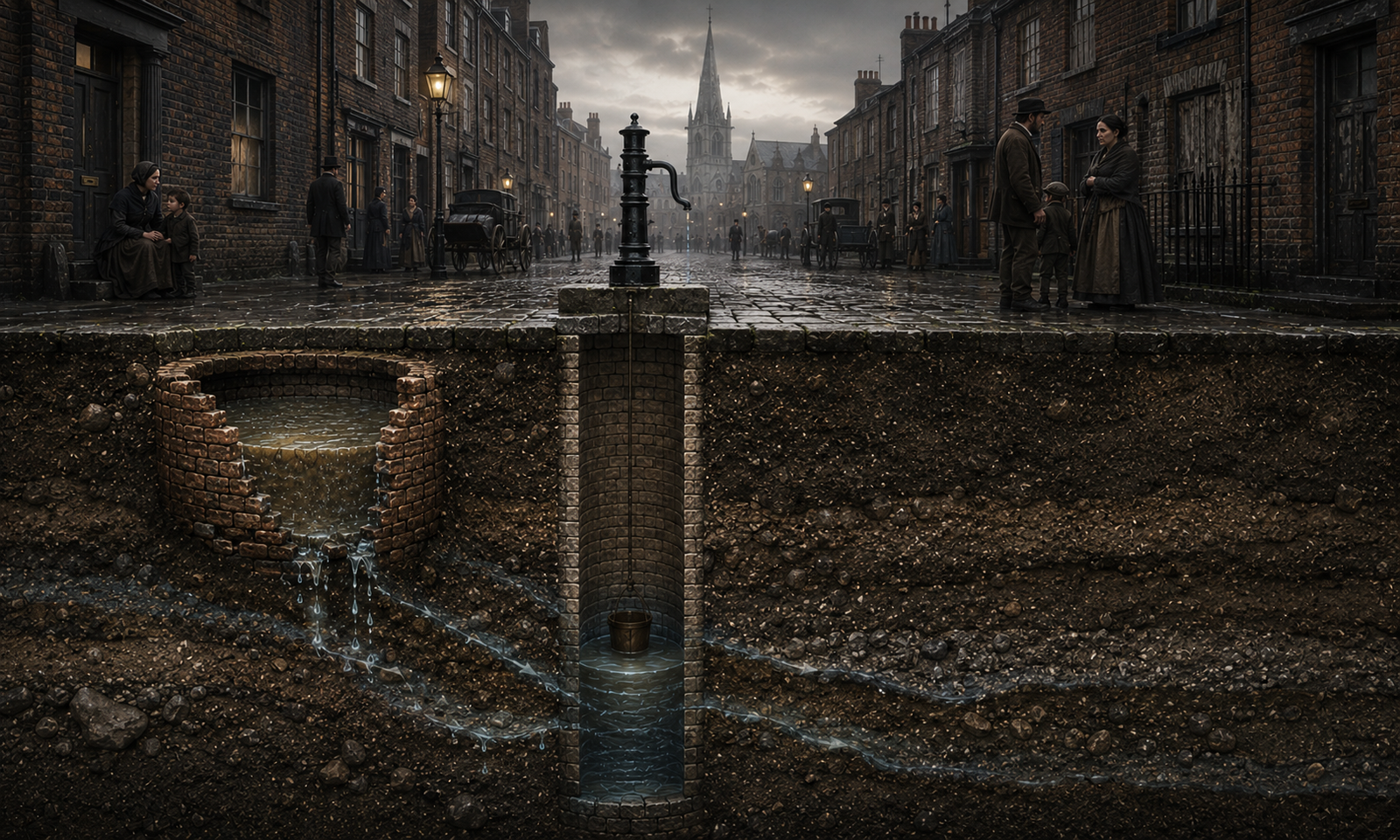
As Whitehead kept interviewing families, another heartbreaking story emerged, centred on a small house just steps from the pump. Weeks before the outbreak, a baby in that house had developed severe cholera. The mother cared for the child and, as any parent would, emptied the dirty wash water into the family’s cesspit — exactly how waste was disposed of throughout Victorian London. What no one realized was that the cesspit had a leak. Hidden underground, contaminated wastewater seeped through the soil toward the well that supplied the Broad Street pump, only a short distance away. Day after day, invisible contamination entered the well, and day after day hundreds of people carried that water home. The pump wasn’t creating cholera. It was distributing it.
For the first time, the entire chain made sense: an infected baby, a leaking cesspit, contaminated groundwater, a popular pump, and hundreds of unsuspecting residents. Snow had never seen the organism responsible — the microscopes of his time couldn’t reveal it — yet through observation and reasoning he had reconstructed the whole chain of transmission with astonishing accuracy. It was detective work of the highest order, except the culprit was something far smaller than anyone could see.
“John Snow never saw the killer. He solved the crime anyway.”
 Add image URL
“One outbreak could be dismissed as a coincidence. But what if an entire city unknowingly became part of the same experiment?”
The Grand Experiment
Today this would be considered overwhelming evidence. In the 1850s it wasn’t enough. Many doctors refused to abandon the Miasma Theory, since accepting Snow’s conclusions meant admitting one of medicine’s most trusted ideas was wrong. Snow understood that scientific revolutions happen one piece of evidence at a time. If one neighbourhood couldn’t convince the establishment, perhaps an entire city could. He designed a study so powerful that even his strongest critics would struggle to explain it away — one involving more than 300,000 Londoners.
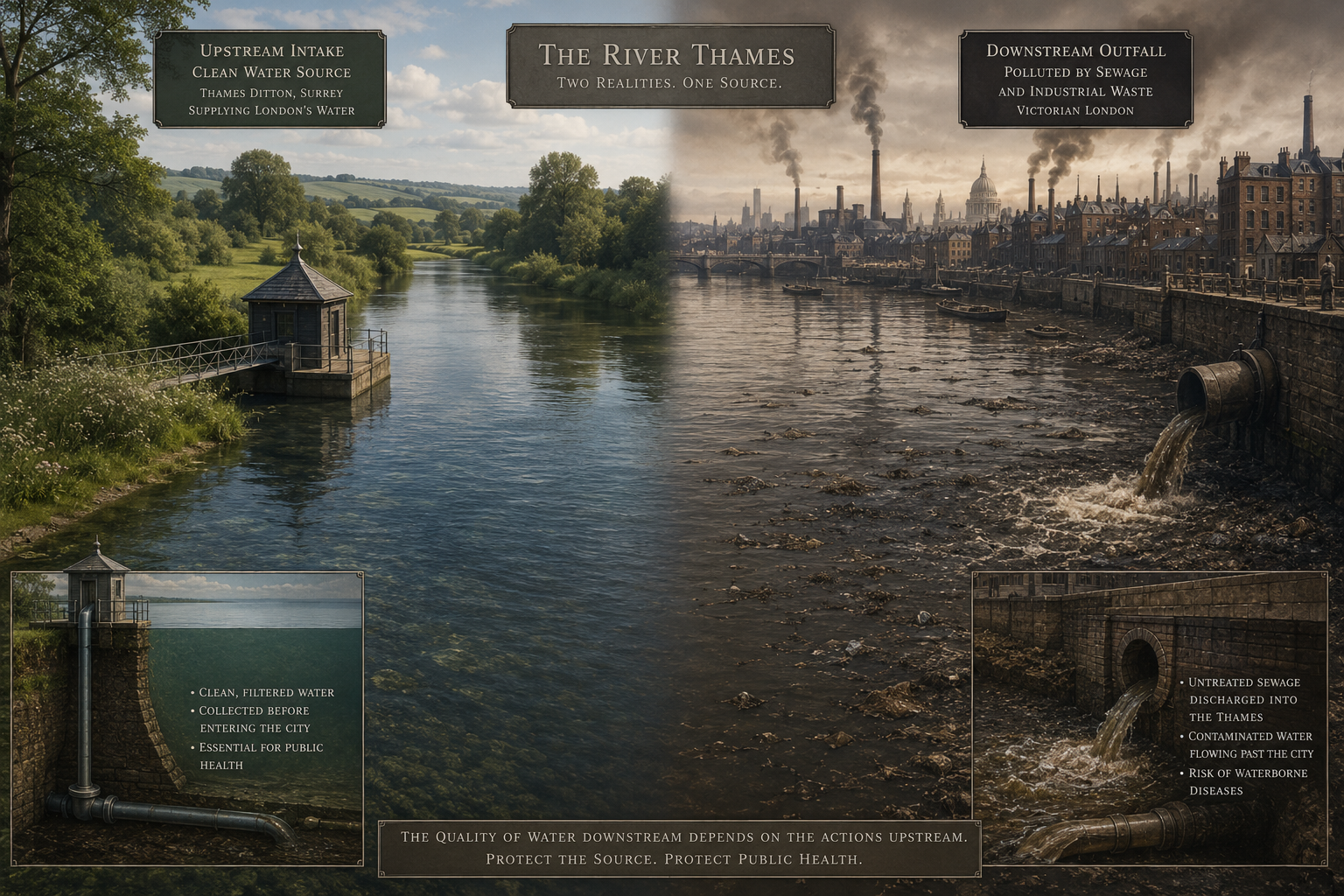
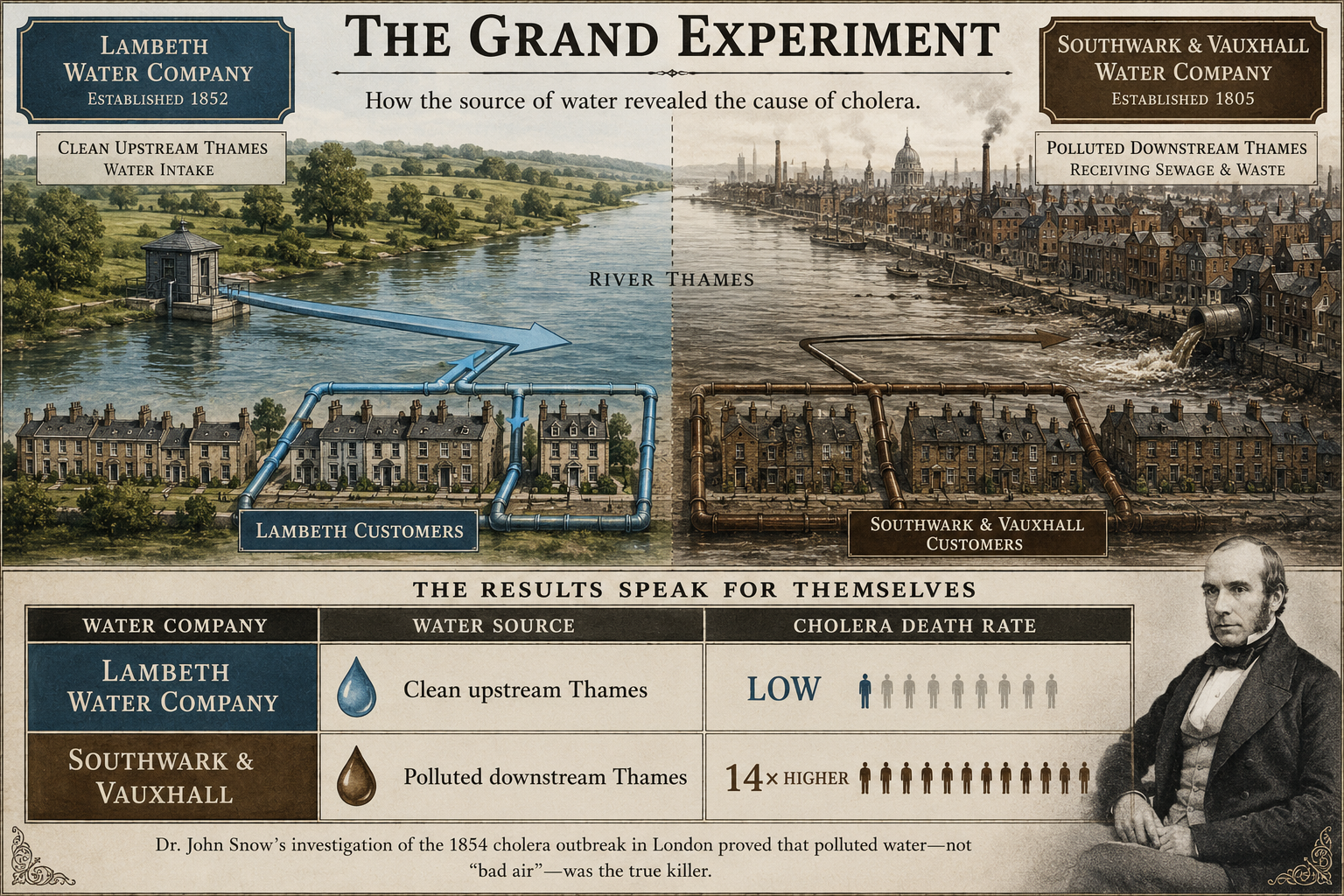
South of the Thames, hundreds of thousands of Londoners received piped water from two competing private firms: the Southwark and Vauxhall Water Company and the Lambeth Water Company. Their pipes often ran down the very same streets, so neighbouring houses could receive water from different companies. To most people it didn’t matter — water was water. But to Snow, one difference stood out: where each company collected its water. Years earlier, Lambeth had moved its intake far upstream, drawing cleaner water from areas still relatively free of sewage. Southwark and Vauxhall still drew its water downstream, exactly where much of the city’s untreated sewage entered the river. The two supplies looked and tasted almost the same, yet one was relatively clean and the other heavily contaminated. Without realizing it, London had become one giant natural experiment.
Snow had no computers or health records — only notebooks, official reports, census data, and extraordinary patience. Working house by house, he compared where cholera deaths occurred with the water company supplying each home, covering more than 300,000 people. It wasn’t glamorous work, yet it would produce one of the greatest pieces of epidemiological evidence ever assembled.
 Add image URL
The Numbers Told Their Own Story
When Snow completed his analysis, the results were astonishing. Homes supplied by Southwark and Vauxhall had a cholera death rate about fourteen times higher than homes supplied by Lambeth.
These weren’t different cities or different social classes. Many families lived on the same streets, their houses side by side, breathing exactly the same air. If the Miasma Theory were correct, both groups should have suffered equally. They didn’t. The only meaningful difference was the water they drank. Snow had demonstrated, on a scale never seen before, that contaminated drinking water — not bad air — was driving cholera. For perhaps the first time in medical history, statistics had solved a public health mystery.
| Water Company | Water Source | Cholera Death Rate |
|---|---|---|
| Lambeth Water Company | Clean upstream Thames | Low |
| Southwark & Vauxhall | Polluted downstream Thames | 14× higher |
What made the study so remarkable was that nature had created the perfect comparison. The families hadn’t chosen to take part or changed their diets — they simply received water from different suppliers because of where the pipes had been laid years earlier. Modern epidemiologists call this a natural experiment, and Snow’s remains one of the earliest and most elegant examples, still taught worldwide. Yet doctors still didn’t change their minds overnight. Many had spent entire careers teaching the Miasma Theory; others argued that polluted water and foul air always occurred together, so how could anyone be sure which was to blame? Without seeing the organism itself, many remained unconvinced. Snow had solved the puzzle — the world just wasn’t ready to accept the answer.
“History teaches us that evidence alone doesn’t always change the world. Sometimes the world has to experience the consequences before it begins to listen.”
 Add image URL
“Some people change the world during their lifetime. Others plant seeds whose true impact is only seen long after they are gone. John Snow belonged to the second kind.”
The Great Stink
Ironically, the event that finally transformed London’s sanitation wasn’t another cholera outbreak, a scientific conference, or a government report. It wasn’t even John Snow. It was a smell.
By the summer of 1858, London had spent years debating cholera while thousands of tons of untreated sewage flowed into the Thames every day. Then the weather intervened. The summer was unusually hot; the river dropped, its flow slowed to a crawl, and years of accumulated sewage began to rot under the blazing sun. Within weeks the smell was unbearable. Even inside the Palace of Westminster, members of Parliament struggled to continue their debates, soaking the curtains in chloride of lime to block the stench. The people who had ignored years of warnings could no longer ignore the smell. The crisis became known as The Great Stink.
Now there was no choice. Parliament approved one of the largest engineering projects Britain had ever attempted, and the man chosen to lead it was not a physician but an engineer: Sir Joseph Bazalgette. He designed an enormous network of underground sewers stretching for hundreds of kilometres beneath London’s streets, carrying sewage far downstream, away from where drinking water was drawn. When the system became fully operational in the 1870s, something remarkable happened: the cholera epidemics that had haunted London for decades simply stopped — not because of a miracle cure, but because contaminated water no longer reached people’s homes. Without intending to, Bazalgette had built the greatest proof of John Snow’s theory.
The Invisible Killer Finally Revealed
There is something deeply moving about Snow’s story. He spent years collecting evidence and challenged one of the strongest medical beliefs of his time, yet he never saw the world fully accept his ideas. John Snow died of a stroke on 16 June 1858, at just 45 — only months before the Great Stink forced Parliament to rebuild London’s sanitation. He never saw Bazalgette’s sewers, never saw cholera vanish from London, and never heard the medical establishment admit he had been right.
Even after sanitation improved, one question still remained: what exactly was causing cholera? Snow had correctly concluded that contaminated water spread it, but had never seen the organism responsible. The final piece arrived twenty-five years later. In 1883, the German physician Robert Koch travelled to Egypt and India to investigate outbreaks and, using improved microscopes, isolated a tiny comma-shaped bacterium that consistently appeared in patients. He named it Vibrio cholerae.
At last the invisible killer had a face. Everything Snow had reasoned through observation and logic was now confirmed under a microscope — one of the greatest vindications in the history of medicine.
A Legacy That Lives On
Today, John Snow is remembered as the Father of Modern Epidemiology — not because he removed a pump handle or won an argument, but because he changed the way we search for the causes of disease. Before Snow, epidemics were explained by superstition, assumption, or tradition. After Snow, outbreaks became mysteries that could be solved with evidence. He showed that every disease leaves clues, that maps can reveal hidden patterns, and that comparing one group with another can uncover the true cause of an epidemic.
These ideas seem obvious now, but in the 1850s they were revolutionary. His work laid the foundation for outbreak investigation, disease surveillance, environmental health, and spatial epidemiology. Whenever public health teams trace a food-poisoning outbreak, map the spread of a new virus, or search for the first patient in an epidemic, they follow the path Snow first walked through Soho more than 170 years ago. The tools have changed — faster computers, digital maps, sophisticated laboratories — but the questions remain the same: Where are the cases? What do they have in common? Where did the outbreak begin? And what is the evidence trying to tell us?
Perhaps the biggest misconception about Snow is that his greatest achievement was removing the pump handle. It wasn’t — the handle was only a symbol. His real achievement was teaching the world that science means following the evidence even when it leads somewhere unexpected, and that preventing disease can save more lives than treating it after it strikes.
“John Snow never saw the bacterium. He never won universal acceptance during his lifetime. He never watched London become healthier because of his ideas. Yet today, every epidemiologist, every outbreak investigator, and every public health professional walks in his footsteps.”
Timeline: The Journey of John Snow
| Year | What happened |
|---|---|
| 1813 | John Snow is born in York, England. |
| 1831 | As a young apprentice, he witnesses his first cholera epidemic. |
| 1849 | Publishes On the Mode of Communication of Cholera, proposing that cholera spreads through contaminated water. |
| 1853 | Administers chloroform to Queen Victoria during the birth of Prince Leopold. |
| 1854 | The Soho cholera outbreak leads to the famous Broad Street investigation, and the pump handle is removed. |
| 1855 | Publishes the expanded second edition of his book, including the Broad Street investigation and the Grand Experiment. |
| 16 Jun 1858 | John Snow dies at the age of 45. |
| Summer 1858 | The Great Stink forces Parliament to modernize London’s sanitation system. |
| 1875 | Sir Joseph Bazalgette’s sewer system is completed, dramatically reducing cholera outbreaks. |
| 1883 | Robert Koch identifies Vibrio cholerae, confirming Snow’s theory. |
| Today | John Snow is celebrated worldwide as the Father of Modern Epidemiology. |