
PHS 01
Why is Public Health Important? 7 reasons explained
Clean water, vaccines, safe food, and disease surveillance. Public health quietly adds years to our lives. Here’s why it matters more than most people realise…
Introduction
When you drink a glass of tap water without falling ill, eat at a restaurant without worrying about food poisoning, or grow up without ever seeing a case of polio, you are experiencing public health at work.
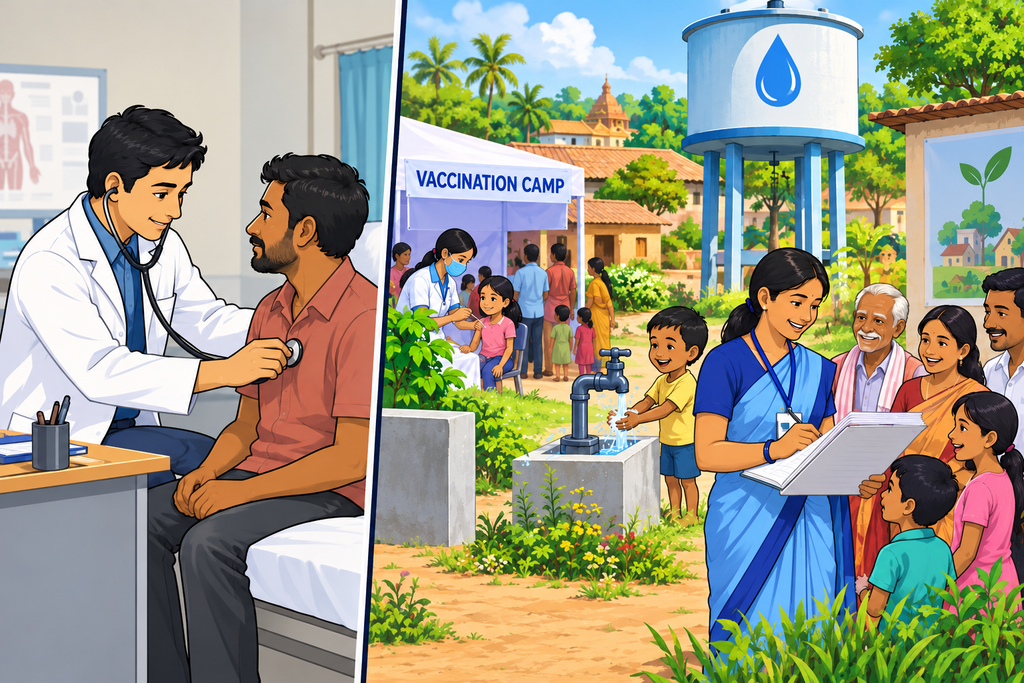
Most of us only notice healthcare when we are sick: the hospital, the doctor, the medicine. But much of the health we enjoy every day comes from work done before anyone falls ill. That is the world of public health.
What Is Public Health?
In 1920, the American public health pioneer C.-E.A. Winslow described public health as the science and art of preventing disease, prolonging life, and promoting health through the organised efforts of society.
Three words in that idea are worth remembering:
- Preventing: stopping disease before it starts
- Organised: it needs systems, not just individuals
- Society: its focus is the whole population, not one patient
7 Reasons Why Public Health Is Important
1. It adds years to our lives!
During the 20th century, life expectancy in the United States rose by about 30 years. The US Centers for Disease Control and Prevention (CDC) attributed about 25 of those years to public health advances. These included vaccination, safer food and water, better maternal and child health, and control of infectious diseases, not hospital treatment alone
2. It prevents disease instead of just treating it
Prevention works at three levels:
| Primary | Stop disease before it starts | Vaccination, clean water, tobacco control |
| Secondary | Detect early and treat | Cancer screening, BP checks |
| Teritary | Reduce complications | Rehabilitation after stroke |
3. It has eliminated diseases that once killed millions
- Smallpox killed hundreds of millions of people over the centuries. After a global vaccination and surveillance campaign, the World Health Assembly declared it eradicated in 1980.
- India was certified polio-free in 2014. This came after a massive immunisation effort reaching every child, including those in the most remote villages.
- India has also been validated as having eliminated maternal and neonatal tetanus (2015).
No single doctor could achieve these. They were won by organised public health action.
4. It is excellent value for money
A systematic review published in 2017 found that public health interventions returned a median of about ₹14 for every ₹1 spent (a 14:1 return on investment). Health protection measures such as legislation and vaccination gave especially high returns.
5. It protects us during outbreaks and pandemics
COVID-19 showed everyone what public health professionals already knew. Disease surveillance, contact tracing, testing, vaccination, and clear communication decide how well a country copes with a crisis. A strong public health system is like a fire brigade: you need it ready before the fire.
6. It addresses the root causes of ill health
Health is shaped less by hospitals and more by where people are born, live, work, and age. These are the social determinants of health: income, education, housing, sanitation, nutrition, and gender. The WHO Commission on Social Determinants of Health (2008) stressed that tackling these conditions is essential to closing health gaps between and within countries.
7. It reduces inequality
Public health programmes are often the main source of care for the poorest and most remote communities. Examples include immunisation drives, ASHA workers, the Anganwadi system, and free medicines under national programmes. Public health helps make health a right, not a privilege.
But… The Public Health Paradox
Here is the strange thing about public health: when it works, nothing happens.
No one celebrates the cholera outbreak that never occurred or the child who never got measles. Success is invisible, and that makes public health easy to underfund and forget. Epidemiologist Geoffrey Rose also pointed out a related idea, the prevention paradox. A measure that brings large benefits to the population may offer little visible benefit to each individual, so people often don’t feel its value personally.
Conclusion
Public health is the quiet foundation beneath modern life. It is in our water, our food, our vaccines, our laws, and our data systems. It has given us longer lives, eliminated deadly diseases, and remains our best defence against future pandemics.
Understanding why public health matters is the first step. In the coming articles, we’ll explore how it works, starting with the basic tools of epidemiology.
References
- Winslow CEA. The untilled fields of public health. Science. 1920;51(1306):23–33.
- Centers for Disease Control and Prevention. Ten great public health achievements—United States, 1900–1999. MMWR Morb Mortal Wkly Rep. 1999;48(12):241–3.
- Fenner F, Henderson DA, Arita I, Ježek Z, Ladnyi ID. Smallpox and its eradication. Geneva: World Health Organization; 1988.
- World Health Organization, Regional Office for South-East Asia. WHO South-East Asia Region certified polio-free [press release]. New Delhi: WHO SEARO; 2014 Mar 27.
- Masters R, Anwar E, Collins B, Cookson R, Capewell S. Return on investment of public health interventions: a systematic review. J Epidemiol Community Health. 2017;71(8):827–34.
- Commission on Social Determinants of Health. Closing the gap in a generation: health equity through action on the social determinants of health. Geneva: World Health Organization; 2008.
- Snow J. On the mode of communication of cholera. 2nd ed. London: John Churchill; 1855.
- Rose G. Sick individuals and sick populations. Int J Epidemiol. 1985;14(1):32–8.